At Thames Valley Cremation Services Inc., we know that grief is a deeply personal journey. While funeral directors are here to guide families through arrangements, we are not counsellors — and we believe in connecting families with those who are.
We are grateful to partner with Kimberley (Kim) Vander Schelde, Grief, Bereavement & Loss Specialist, Thanatologist, and Sam Vander Schelde, BSW, MSW, RSW, Thanatologist, of This Thing Called Grief, located at Western Research Parks in London, Ontario. Together, Kim and Sam bring years of experience in grief, bereavement, and loss support.
If you need assistance, please reach out directly to Kim and Sam at This Thing Called Grief:
Western Research Parks – Mogenson Centre
100 Collip Circle, Suite 245
London, ON N6G 0J3
Dear Grief with Kim & Sam is a monthly column where Kim and Sam respond to anonymous questions and stories about death, dying, and grief. Think of it as something like Dear Abby — but dedicated to life’s most tender moments of loss and love. This is the first program of its kind.
Every family’s journey is unique, and your questions and stories guide the conversation. You don’t need to share your name — just your questions, thoughts, or memories.
Submit your anonymous question or story through our Message Board, and it will be sent directly to Kim and Sam. This column is not for profit; it exists to comfort our community. Your message may be featured in a future column. Thames Valley Cremation Services Inc. is proud to provide this platform for open, honest conversations about grief.
Thames Valley Cremation Services Inc. provides grief resources and articles for educational purposes. As a licensed funeral service provider, our role is to guide families through the practical and professional aspects of funeral care — it does not extend into counselling or therapy.
However, we recognize how important grief support is, and we are proud to offer this platform as a safe space for connection. The Dear Grief with Kim & Sam column is independently managed by Kim and Sam of This Thing Called Grief. Thames Valley Cremation Services Inc. will not be part of the conversations shared in this column, but we wholeheartedly support their work and the importance of compassionate grief care in our community.
If you are in crisis, please call 911 or visit your nearest emergency department. Additional support is also available through CMHA Thames Valley and other local community services.
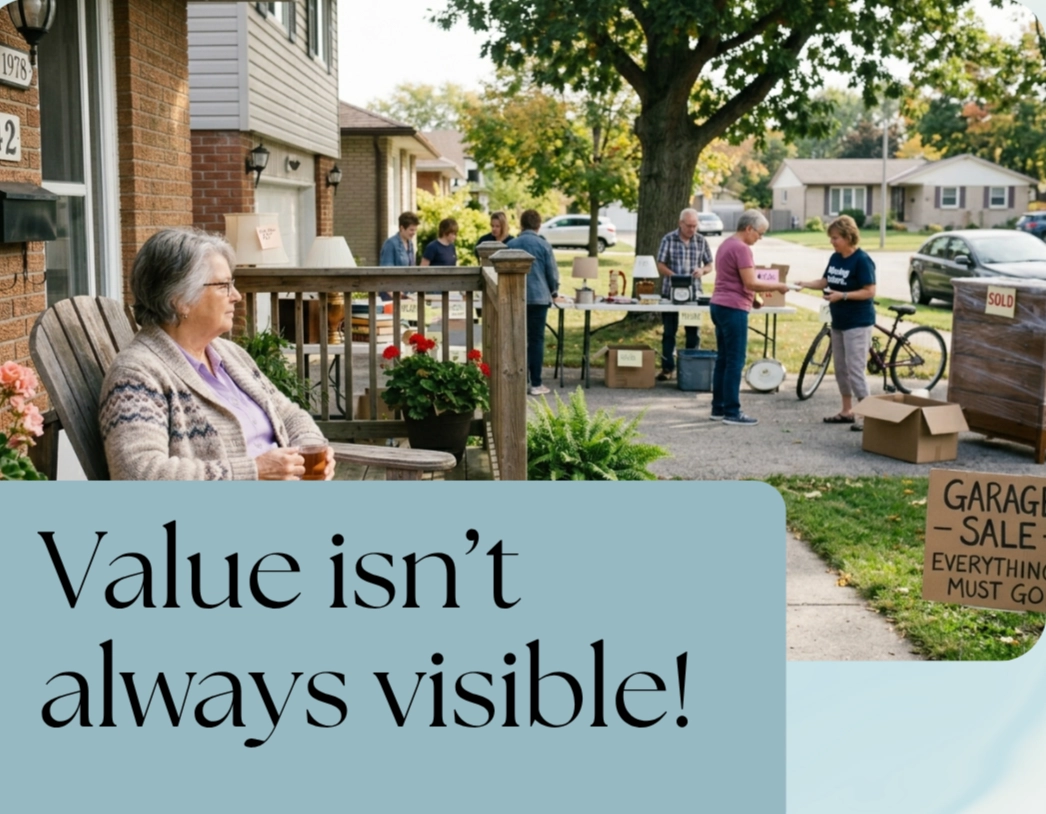
We have all heard the saying, “one man’s junk is another man’s treasure.”
But I find myself coming back to it in a different way.
So often, what is someone’s treasure is seen as meaningless by someone else’s standards. And more often than not, that someone is family not because they don’t care, but because they are looking at it through a different lens, one shaped by practicality, by space, by what feels necessary in the moment.
It usually happens during a transition a move into a different living arrangement, often a downsizing that isn’t really a choice, but something that has to happen. The people helping are trying to do the right thing, looking at space, at logistics, at what fits and what doesn’t, trying to make decisions that feel responsible, even helpful.
And then, almost without thinking, the words come: “It’s not worth anything.”
I hear that a lot. And every time I hear it, I pause… because I don’t think we always mean what we think we mean when we say it. I think sometimes we are talking about money, about resale, about practicality… but it lands somewhere much deeper than that.
Not worth anything to who?
Because if we are talking about money, maybe that’s true.
But if we are talking about a life…
worth looks very different.
Worth is the chair where someone sat up all night with a sick child, the fabric worn down in the same place from years of being leaned into, held onto, needed.
Worth is the dishes that held every holiday meal, the ones with the small chips along the edges, kept not because they were perfect, but because they were always part of the table, part of the gathering, part of the memory.
Worth is the quiet, ordinary things that carried love without ever asking to be noticed, the things that simply showed up, over and over again, in the background of a life.
Worth is often found in the things no one else would ever think to keep.
When someone is transitioning to a different living arrangement, they are not just moving… they are leaving behind pieces of a life that once felt certain.
They are losing pieces of their independence.
Their routine.
Their sense of control.
There is grief in that.
Even if no one names it.
And when dementia is part of the picture, familiarity becomes everything. It is found in the smallest, most ordinary details the way a drawer is organized, what is kept in a cupboard, where a chair sits in a room.
These are not small things. They are the pieces that help someone make sense of their surroundings, the quiet markers that tell them they are safe in a world that is slowly becoming unfamiliar.
I have seen the difference it makes when this is understood… and when it isn’t.
There are companies, like ONESource Moving Solutions, who take the time to really see the person behind the move.
They will photograph the inside of a cabinet so it can be set up the same way in a new space.
Not because it looks nice, but because it feels the same.
Because it helps someone find their way.
Because it reduces confusion.
Because it is kind.
And I don’t think we talk enough about that kind of kindness.
That is what worth looks like to me.
Not something you can price.
Something you protect.
Downsizing can be relieving, even healing…
but only when it is done with care.
When we remember that we are not just sorting through things…
we are moving through someone’s life.
And that deserves more than efficiency.
It deserves compassion.
Because what may look like “just things”…
is often everything.
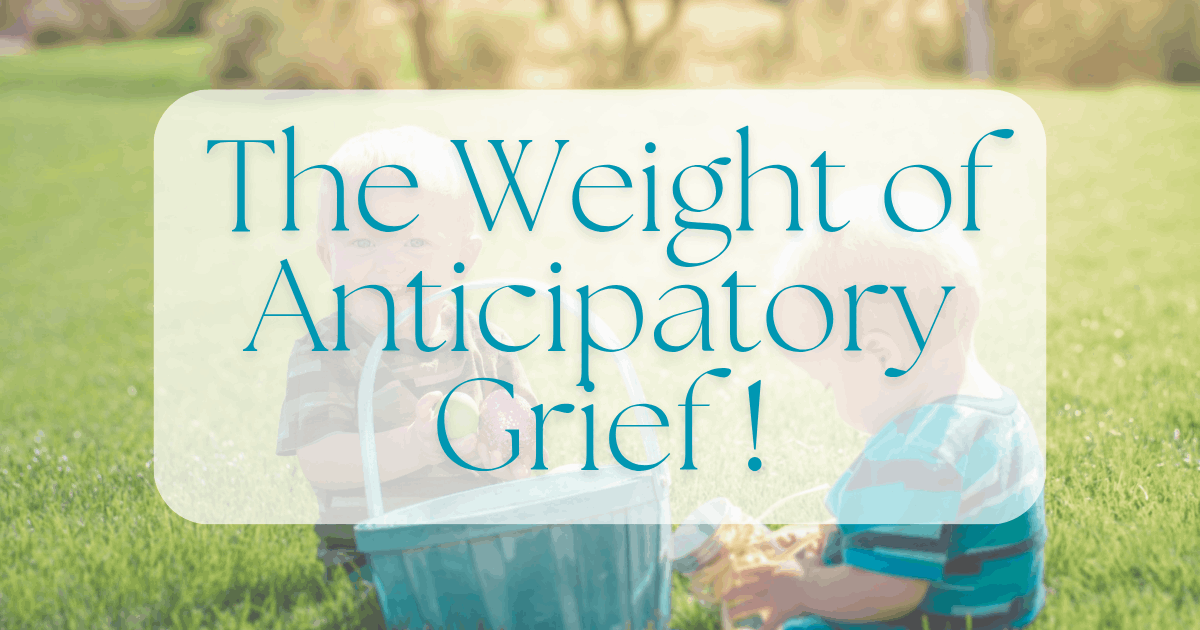
The Weight of Anticipatory Grief at Easter
For many of us, Easter carries a sense of hope.
A time of new beginnings.
We begin to notice the trees again, just starting to show a hint of green. If we’re lucky, something pushes up through the soil in our gardens quiet reminders that life continues.
But for those living with a life limiting illness…
or loving someone who is…
Easter can feel very different.
It can feel heavy.
Because while the world around you may be waking up,
you may be moving through something that asks everything of you.
You may be wondering if this is the last Easter.
The last photo.
The last shared meal.
And suddenly, things that once felt simple
feel incredibly hard.
It may be harder to take the pictures.
Harder to find the words.
Harder to watch the day turn into night, knowing time feels different now.
This is anticipatory grief.
It is the grief that begins before the loss.
The grief that quietly sits beside love, even while someone is still here.
And there is no right way to move through it.
If celebrating feels like too much this year,
that is okay.
If your version of Easter looks quieter, smaller, or different than it once did,
that is okay.
And if you find yourself putting on a brave face so others don’t see your sadness…
please know, you don’t have to.
The weight you are carrying is heavier than most can imagine.
It deserves space.
It deserves to be acknowledged.
We are all walking toward loss in our own time,
but we don’t talk about it nearly enough.
You are not alone in this, even if it feels that way.
And if you or someone you love is living with a life limiting illness,
I hope you are able to find someone you trust to talk to.
Someone who can sit with you in the truth of what this moment holds.
Not to fix it.
Not to rush it.
Just to be there.
Because sometimes, that kind of presence
is what carries us through.
This Thing Called Grief April 2026
Response to London Free Press Article on Funeral Trends
Reading this article, I found myself wanting to gently reframe part of the conversation.
One of the most important things to clarify is this: how we grieve has not changed.
Grief itself, love, loss, longing, remembrance, those are constants. What has changed is that many people now feel comfortable pushing against what used to be an unspoken expectation of what a “proper” funeral looked like, complete with finger sandwiches and organ music. Today, people are asking different questions: What feels right and reflects who they were?
That shift is not about disengagement, it is about autonomy.
I think of it like Blockbuster. There was a time when we all rushed in to rent the newest movies, and it felt like the only way to do it. If someone had told us then that one day there would be only one left, we would not have believed them. But we did not stop watching movies, we simply found ways that better suited our lives.
Grief is no different.
I do, however, share some of the concerns raised around the increasing corporatization of death care. Many families, including my own, have placed trust in long standing funeral providers, believing they are making responsible and thoughtful decisions when prearranging services.
In our case, we later learned, during an already difficult time, that the costs were significantly higher than comparable options. It was a difficult realization, not because of grief itself, but because of the added financial stress at a time when families are already vulnerable.
This highlights the importance of transparency and informed decision making, especially as the landscape of funeral services continues to evolve.
I genuinely want to see family run funeral homes continue to thrive. They have long been part of the fabric of our communities. At the same time, I want families to know that there are affordable alternatives, and that meaningful goodbyes are not defined by cost.
Finances are part of this conversation, but perhaps not in the way they are often framed. People are not stepping away from traditional services because they care less. They are making decisions within the reality of rising living costs. Many families are struggling to afford basic necessities, and in that context, choices around end of life services naturally shift.
If we are truly concerned about dignity, then perhaps the conversation needs to begin earlier.
Instead of focusing solely on funding a dignified death, we might ask how we ensure a dignified life, especially for seniors and vulnerable individuals navigating financial strain.
Because when people feel supported in life, they are better able to navigate loss in ways that feel meaningful to them.
People are not changing the way they grieve; they are simply grieving less on other people’s terms.
This Thing Called Grief
March 2026
I feel like everyone has forgotten my son.
No one talks about him. No one says his name.
It feels like our friends and even our family don’t want to be around us anymore.
I keep trying to figure out what we did wrong.
— Parent
First, let me say this!
"You did nothing wrong".
"Nothing!"
What you are feeling is one of the loneliest parts of grief, the silence that follows the casseroles. The way the world seems to quietly move on while you are still standing in the rubble.
When a child dies, time does not work the same way for parents as it does for everyone else. For you, he is still your son. You are still his parent. That does not expire.
But for others? They often grow quiet not because they have forgotten him, but because they are afraid.
Afraid to say his name and make you cry.
Afraid to remind you of what you have lost.
Afraid of saying the wrong thing.
Afraid of their own discomfort.
So they say nothing.
And that nothing can feel like erasure.
Please know this: silence is not proof that he is forgotten. It is often proof that people do not know how to step into sacred pain.
Here is something else that may be hard to hear but important:
People withdrawing is rarely about something you have done. Grief changes us. It rearranges priorities. It strips away small talk. It can make others confront their own fears about loss, about children, about fragility. Not everyone has the capacity to sit beside that.
That is not a reflection of your worth.
It is a reflection of their limits.
You are allowed to say his name.
You are allowed to bring him into conversations.
You are allowed to say, “I love when people talk about him. It keeps him close.”
Sometimes people need permission.
And sometimes, we discover who can stay and who no longer works in our life.
Your son mattered. He matters still.
Love like yours does not disappear because others grow quiet.
If you ever wonder whether he is remembered I promise you this:
The depth of your longing tells me how deeply he was loved.
And that kind of love leaves an imprint that cannot be erased.
With care,
Kim & Sam
This Thing Called Grief
February 2026
This will be the first Family Day without my sister.
How do I get through it?
How do I spend the day with my kids and act like I am okay?
— M.R.
You don’t.
You don’t act like everything is okay.
You honour what is true.
Family Day can feel especially heavy when someone is missing. The word “family” itself can feel like a spotlight on the empty chair. And pretending everything is fine doesn’t protect your children — it teaches them that hard feelings should be hidden.
Depending on the age of your children, they are grieving too. They may not have the same words for it. They may show it in different ways. But they feel the absence.
Instead of acting okay, consider being honest in a way that feels safe and steady:
“I’m feeling sad today because I miss Auntie. It’s okay to feel sad and still be together.”
Grief and love can sit at the same table.
You might gently weave your sister into the day:
• Create a small memory box and invite your children to add drawings, photos, or little objects that remind them of her.
• Go for a drive to a place she loved.
• Make her favourite dessert.
• Tell one funny story about her at dinner.
Let the day hold both laughter and tears.
Children learn emotional safety by watching us feel our feelings without being overwhelmed by them. You don’t have to be perfectly composed. You just have to be real.
It is okay to miss her.
It is okay to cry.
It is okay to smile at a memory.
It is okay for this day to look different than it used to.
Family Day is not about pretending your family hasn’t changed. It is about loving the family you have including the sister who will always be part of it.
With care,
Kim & Sam
This Thing Called Grief
February 2026
Because with death comes grief. Mortality is the one thing that unites us all. Regardless of race, religion, political alignment, or economic status, it will come to fruition. Death is inevitable. And grief is what’s left behind.
Grief is not something you “get over.” It’s not an obstacle to overcome or a finish line you eventually cross. Grief is a chronic condition of the heart, something you learn to maintain, to live with, and to tend to over time. Some days it’s quiet, and other days it demands all your attention. But it never truly disappears.
You can’t love someone and then simply move on as if that love never existed. The depth of your grief is the measure of your love. Grief, in its most basic definition, is the emotional response to loss, but when you translate that to love, it becomes something much deeper.
Grief is love with nowhere to go. It’s love that no longer has a physical form to hold onto, so it lingers in memories, in the scent of a shirt, in the sound of laughter that lives only in your mind. Grief is the reminder that someone mattered so much, their absence reshaped your world.
Over time, you don’t heal from grief; you grow around it. You learn to build a life that holds both the love and the loss. You find ways to carry the memory forward in stories, in kindness, in quiet acts of remembrance.
So perhaps grief isn’t a sign that something is wrong with us, but rather, that something was profoundly right. It means we have loved deeply. And that love, though changed, never truly dies.
– Reflection - Kim Vander Schelde,